
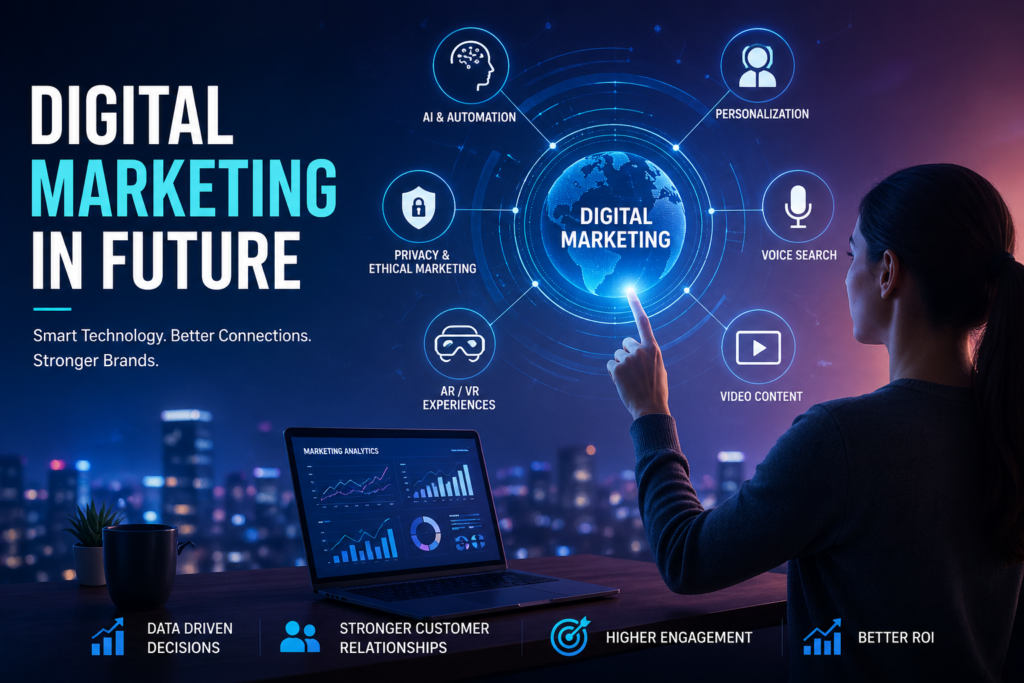
Digital marketing is evolving faster than ever before. With technology advancing rapidly, businesses must adapt to new trends and strategies to stay competitive. The future of digital marketing will be shaped by artificial intelligence, automation, personalization, voice search, and immersive technologies.
1. Artificial Intelligence Will Lead Marketing Strategies
Artificial Intelligence (AI) is already transforming digital marketing. In the future, AI will become even more powerful in analyzing customer behavior, predicting trends, and automating campaigns. Chatbots, AI-powered content creation, and predictive analytics will help businesses deliver faster and smarter customer experiences.
2. Hyper-Personalization Will Become Standard
Customers no longer respond well to generic advertisements. Future digital marketing will focus heavily on personalized content, product recommendations, and targeted communication based on user interests, browsing behavior, and purchase history.
For example, websites and apps will automatically show different products, offers, or content depending on each visitor’s preferences.
3. Voice Search Optimization Will Be Essential
As smart devices like Alexa, Siri, and Google Assistant continue growing, voice search will become a major part of online discovery. Businesses will need to optimize content for conversational keywords and question-based searches.
Instead of typing “best marketing agency,” users may ask, “Which is the best digital marketing agency near me?”
4. Video Content Will Dominate
Short-form videos, live streaming, and interactive video content will continue dominating platforms like YouTube, Instagram, TikTok, and LinkedIn. Brands that invest in creative video storytelling will have stronger engagement and higher conversion rates.
Video will not just entertain—it will educate, build trust, and drive sales.
5. Augmented Reality (AR) and Virtual Reality (VR) Marketing
Future customers will expect immersive experiences. AR and VR will allow users to virtually try products, explore stores, or experience services before making purchases.
For example, fashion brands may let customers “try on” clothes virtually using mobile apps.
6. Privacy and Ethical Marketing Will Matter More
As users become more aware of data privacy, businesses must prioritize transparency and ethical marketing practices. First-party data, permission-based marketing, and secure customer relationships will become increasingly important.
Conclusion
The future of digital marketing is exciting, data-driven, and customer-focused. Businesses that embrace AI, personalization, video content, voice search, and ethical practices will gain a competitive advantage. Digital marketing is no longer just about selling products—it is about creating meaningful and seamless customer experiences.
The future belongs to brands that innovate today.