
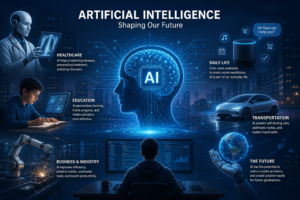
 Artificial Intelligence: Transforming the Future of Technology
In today’s digital world, one of the most talked-about technologies is Artificial Intelligence . From smartphones to self-driving cars, Artificial Intelligence is becoming a major part of our daily lives. Businesses, educational institutions, healthcare systems, and even entertainment platforms are increasingly using Artificial Intelligence to improve efficiency and deliver better experiences.
Artificial Intelligence is transforming the way people work, communicate, learn, and solve problems. Tasks that once required human effort can now be automated using intelligent systems. As technology continues to evolve, Artificial Intelligence is expected to become even more integrated into everyday life.
Artificial Intelligence is not just a futuristic concept anymore. It is already influencing how we search online, shop on e-commerce platforms, interact with social media, and use digital services. Understanding Artificial Intelligencehas become important for students, professionals, entrepreneurs, and businesses alike.
What is Artificial Intelligence?
Artificial Intelligence refers to machines or software systems that can perform tasks that usually require human intelligence.
These tasks include:
Learning from data
Solving problems
Making decisions
Understanding language
Recognizing images and patterns
Predicting outcomes
Automating repetitive tasks
In simple terms, Artificial Intelligence enables machines to think, learn, and act in ways similar to humans.
Artificial Intelligence systems are designed to analyze large amounts of data, identify patterns, and improve their performance over time. Unlike traditional software, Artificial Intelligence can learn from experience and adapt to new information.
Examples of AI in Daily Life
Many people use Artificial Intelligence every day without even realizing it.
Examples include:
Virtual assistants like Siri, Alexa, and Google Assistant
Netflix and YouTube recommendations
Chatbots like ChatGPT
Face recognition systems
Self-driving vehicles
Smart home devices
Online shopping recommendations
Spam email filters
Navigation apps like Google Maps
These technologies use Artificial Intelligence algorithms to improve user experience and provide personalized services.
How Does|Work?
Artificial Intelligence mainly works through a concept called Machine Learning (ML). Machine learning allows computers to learn from large amounts of data without being explicitly programmed for every task.
For example, if an Artificial Intelligence system is trained using thousands of images of cats and dogs, it can later identify whether a new image is a cat or a dog.
The more data an Artificial Intelligence system receives, the more accurate and intelligent it becomes.
Key Technologies Behind AI
1. Machine Learning (ML)
Machine Learning allows systems to learn from data and improve automatically without human intervention.
Examples:
Recommendation systems
Fraud detection
Predictive analytics
2. Deep Learning
Deep Learning is a more advanced form of machine learning that uses neural networks inspired by the human brain.
It is used in:
Image recognition
Speech recognition
Autonomous vehicles
Medical diagnosis
3. Natural Language Processing (NLP)
NLP helps machines understand and process human language.
Examples include:
Voice assistants
Translation apps
Chatbots
Speech-to-text systems
4. Computer Vision
Computer Vision enables machines to understand and analyze images and videos.
Applications include:
Facial recognition
Medical imaging
Security surveillance
Self-driving cars
Types of Artificial Intelligence
AI can be categorized into different types based on capabilities.
1. Narrow AI
Narrow AI is designed to perform a specific task.
Examples:
Google Assistant
Netflix recommendations
Face recognition systems
Most AI systems used today are Narrow AI.
2. General AI
General AI refers to machines that can perform any intellectual task similar to humans. This type of AI is still under development and does not yet fully exist.
3. Super AI
Super AI is a theoretical concept where machines become more intelligent than humans. It remains a topic of research and debate.
Applications of AI
1. Healthcare
AI helps doctors diagnose diseases faster and more accurately.
It is used in:
Medical imaging
Drug discovery
Robotic surgeries
Patient monitoring
Predictive healthcare analytics
AI can improve treatment efficiency and reduce medical errors.
2. Education
AI-powered learning platforms provide personalized education experiences based on students’ learning speed and preferences.
Examples:
Smart learning apps
Automated grading systems
Virtual tutors
Language learning platforms
AI makes education more accessible and interactive.
3. Business
Businesses use AI for:
Customer support
Marketing automation
Fraud detection
Data analysis
Inventory management
Sales forecasting
AI helps companies make faster and smarter business decisions.
4. Entertainment
Streaming platforms use AI to recommend movies, songs, and videos based on user preferences.
AI is also used in:
Gaming
Video editing
Music generation
Social media algorithms
5. Transportation
AI is the driving force behind:
Autonomous vehicles
Traffic prediction
Route optimization
Smart transportation systems
AI can improve road safety and reduce travel time.
6. Finance
Banks and financial institutions use AI for:
Fraud detection
Credit scoring
Risk analysis
Automated trading
Customer service chatbots
AI improves security and financial decision-making.
Benefits of AI
AI offers several advantages across industries and daily life.
✅ Faster Task Completion
AI systems can process information and complete tasks much faster than humans.
✅ Reduced Human Error
Automation reduces mistakes in repetitive and data-heavy tasks.
✅ 24/7 Availability
AI-powered systems can work continuously without breaks.
✅ Better Data Analysis
AI can analyze massive amounts of data quickly and accurately.
✅ Increased Productivity
Businesses can improve efficiency and save time using AI-powered tools.
✅ Improved Customer Experience
AI enables personalized recommendations and faster customer support.
Challenges of AI
Despite its benefits, AI also comes with challenges and concerns.
❌ Job Displacement
Automation may replace certain repetitive jobs, creating employment challenges.
❌ Privacy Concerns
AI systems collect and analyze large amounts of user data, raising privacy issues.
❌ Bias in AI Systems
AI can sometimes produce biased results if trained on biased data.
❌ Ethical and Security Issues
There are concerns regarding misuse of AI, cybersecurity threats, and ethical decision-making.
❌ Dependence on Technology
Overdependence on AI may reduce human involvement in critical decision-making.
The Future of AI
AI is expected to play an even bigger role in the future. Industries such as healthcare, finance, education, agriculture, and manufacturing are rapidly adopting AI technologies.
Future developments may include:
Smarter virtual assistants
Advanced robotics
AI-powered healthcare systems
Fully autonomous transportation
Intelligent smart cities
AI is also expected to create new career opportunities in areas like:
Data Science
AI Engineering
Machine Learning
Robotics
Cybersecurity
Rather than fearing AI, people should focus on understanding and learning how to work alongside it.
Continuous learning and digital skills will become increasingly important in the AI-driven world.
Importance of Learning AI
As AI continues to grow, learning about AI and technology can provide major career advantages.
Students and professionals can benefit by developing skills in:
Programming
Data analysis
Machine learning
Problem-solving
Digital communication
Even basic knowledge of AI can help individuals stay relevant in the future job market.
Conclusion
Artificial Intelligence is more than just a technological advancement—it is a powerful force transforming how we live and work.
From healthcare and education to business and entertainment, AI is improving efficiency, innovation, and decision-making across industries.
When developed and used responsibly, AI has the potential to improve lives, solve complex problems, and shape a smarter future.
As technology continues to evolve, understanding AI will become essential for individuals and businesses aiming to succeed in the digital age.